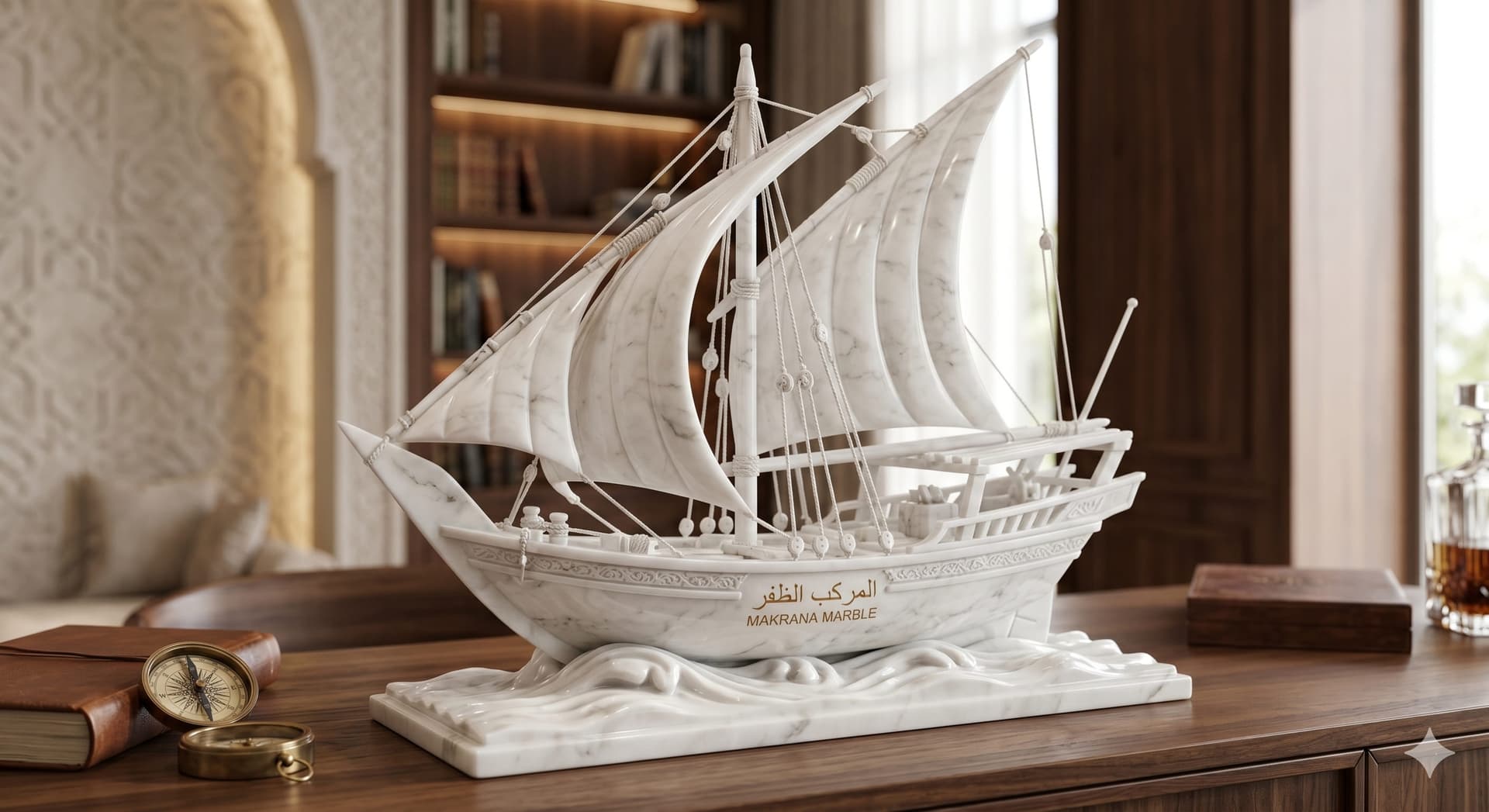
There is no school for Makrana marble carving. There is no manual, no apprenticeship programme, no certification course. The knowledge that produced the ceilings of the Dilwara Temples, the inlay work of the Taj Mahal, and the sculptures in the Sang-e-Taj collection exists in one place: the hands of the artisan families of Makrana, Rajasthan.
These families have been working the stone for generations — in many cases, tracing their craft lineage directly to the teams of carvers who worked on the Taj Mahal under Shah Jahan's patronage in the 17th century. The knowledge passes from father to son on the workshop floor. It cannot be taught in a classroom and it cannot be acquired quickly.
What the Artisan Knows
Before a chisel touches a block of Makrana marble, an experienced artisan has already read the stone. They assess the grain direction — the orientation of the crystal structure — which determines which cutting angles will produce clean edges and which will cause chipping. They evaluate the density by sound, tapping the surface and listening for variations that indicate internal fractures invisible to the eye. They judge the colour consistency in different light conditions.
This assessment cannot be done by machine. It requires the accumulated experience of years of daily work with the specific stone. An artisan who has spent twenty years working Makrana marble reads a block in minutes. A trained engineer with laboratory equipment would miss what the artisan sees.
The Stages of the Work
A Sang-e-Taj sculpture passes through multiple artisan hands, each responsible for a specific stage of the work. This is not an assembly line — each artisan is a specialist whose contribution requires its own mastery.
- ◆The rough carver establishes the primary three-dimensional form — removing the majority of material and defining the overall silhouette of the piece.
- ◆The surface carver refines the geometry: smoothing transitions, correcting proportions, and removing the marks left by the rough carving tools.
- ◆The detail carver executes the fine work — individual rigging lines on a dhow, bodywork creases on an automobile, decorative elements on any bespoke form. This stage can take longer than all preceding stages combined.
- ◆The polisher brings the surface to its final condition, working through progressively finer grits to achieve the specific surface quality specified in the brief.
The Lead Artisan
Each Sang-e-Taj commission is assigned a named lead artisan. This person oversees every stage of the work, makes decisions about tool selection and technique at points of difficulty, and gives final approval before the piece leaves the workshop. Their name, generation, and the period during which they worked on the commission are documented in the Certificate of Makrana Origin that accompanies every completed piece.
This documentation is permanent. In fifty years, the owner of a Sang-e-Taj sculpture can read the certificate and know the name of the man whose hands shaped the stone. That connection between object and maker is not common in the luxury market. It is the Makrana tradition made visible.
Why This Matters for the Object
The technical quality of a hand-carved Makrana marble sculpture depends entirely on the artisan who makes it. No two carvers produce identical results — their training, their tools, their experience with specific forms all leave traces in the finished work. This is not a deficiency; it is what makes each piece genuinely singular. A Sang-e-Taj sculpture is not manufactured. It is made, by a specific person, from a specific block, in a specific period of time that will not be repeated.