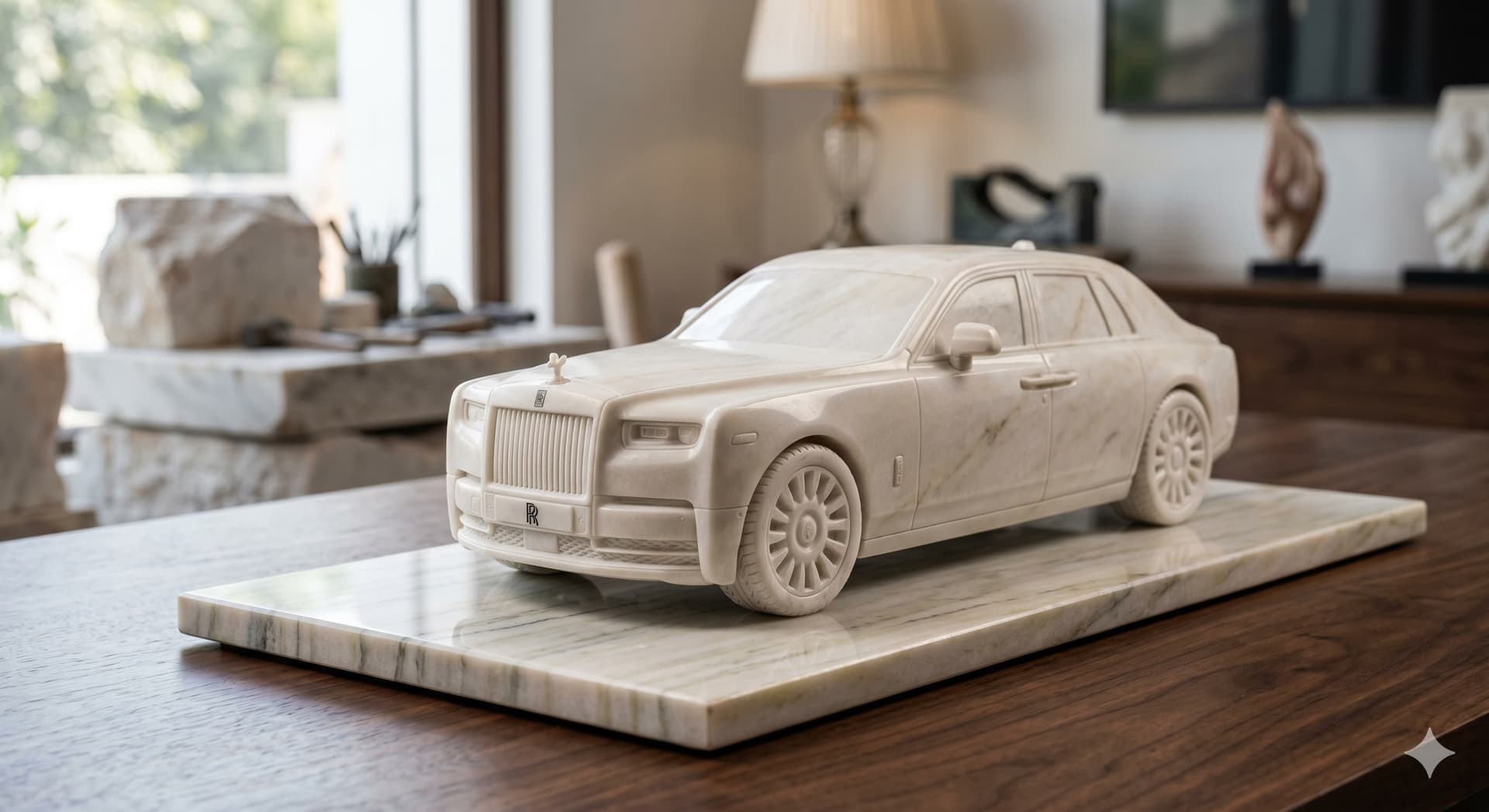
A Sang-e-Taj marble sculpture begins as a block of Makrana white weighing anywhere from 50 to several hundred kilograms. It ends, six to sixteen weeks later, as an object that may weigh a few kilograms — the difference between start and finish weight existing in the form of the pile of marble dust and chips that accumulate on the workshop floor. Everything that is not the sculpture has been removed, by hand, one tool-stroke at a time.
This is a record of the process — what happens at each stage, who does it, and what decisions are made along the way.
Stage 1 — Block Selection
The process begins before any carving tool is picked up. The lead artisan visits the quarry or reviews a selection of blocks to find one suitable for the specific commission. The assessment examines colour uniformity in multiple light conditions, grain direction and consistency, absence of internal fractures (tested acoustically — a clean block rings clearly when struck; a fractured block sounds dull), and overall dimensions relative to the planned sculpture.
This stage is often underestimated by buyers. A poor block choice cannot be corrected later. An internal fracture discovered mid-carving can split a piece that took weeks of work to develop. Block selection is the first and most consequential quality control in the entire process.
Stage 2 — Reference and Layout
Once the block is selected, the lead artisan works from reference — photographs, scale drawings, or physical reference objects provided as part of the commission brief. The key dimensions and proportions are marked on the block surface using chalk or pencil. The orientation of the piece relative to the stone's grain direction is decided at this stage and does not change.
Stage 3 — Rough Carving
The rough carver removes the majority of excess material using large chisels and mallets, sometimes assisted by angle grinders for initial shaping passes. The aim at this stage is to establish the overall three-dimensional form — the primary silhouette and major volumes — without attempting detail. Speed matters here; the rough carver works efficiently, leaving generous material margins that will be refined in subsequent stages.
The rough stage produces the most material waste and generates the most noise, dust, and physical effort. It is the least finished stage of the work but arguably requires the most spatial intelligence — the ability to see the finished form inside the block before it exists.
Stage 4 — Surface Refinement
The surface carver takes the rough form and removes the marks left by the rough carving tools, corrects proportions, smooths transitions between volumes, and brings the piece to within a few millimetres of its final geometry. Smaller chisels and riffler files are used at this stage. The work is slower and more precise.
Stage 5 — Detail Carving
This is the most time-intensive stage and the one that most visibly defines the quality of the finished piece. The detail carver executes the fine work — individual rigging lines on a dhow, body panel creases on an automobile, structural details, inscriptions, or decorative elements on any bespoke form. Very fine chisels, dental tools, and hand files are used. Water is applied continuously to prevent overheating and to keep the work surface clear of dust.
The detail stage on a complex piece — a full-rigged dhow with standing and running rigging, a car with panel gaps and window surrounds — can take longer than all preceding stages combined. This is the work that determines whether the finished object reads as a precision sculpture or a rough approximation.
Stage 6 — Polishing
The polisher works through a sequence of progressively finer abrasive grits — beginning with coarse wet-and-dry paper and ending with ultra-fine polishing compounds — to bring the surface to its final condition. The polishing stage is where Makrana marble's distinctive luminosity becomes fully visible. As the surface is refined, it transitions from opaque and chalky to the deep, crystalline whiteness characteristic of high-grade Makrana.
The final surface specification — high gloss, satin, or matte — is determined by the last stages of the polishing sequence. Most Sang-e-Taj pieces are finished to a semi-gloss that preserves surface detail while expressing the full depth of the stone.
Stage 7 — Inspection and Documentation
The lead artisan conducts a final inspection of the completed piece, comparing it against the original brief and reference. Any corrective work is done at this stage before the piece is approved. Following approval, the provenance documentation is completed: the Certificate of Makrana Origin recording the stone source, the artisan's name and generation, and the commission period.
The piece is then crated in a custom-built timber case with foam-lined internal supports shaped to the specific form of the sculpture. It is ready to ship.