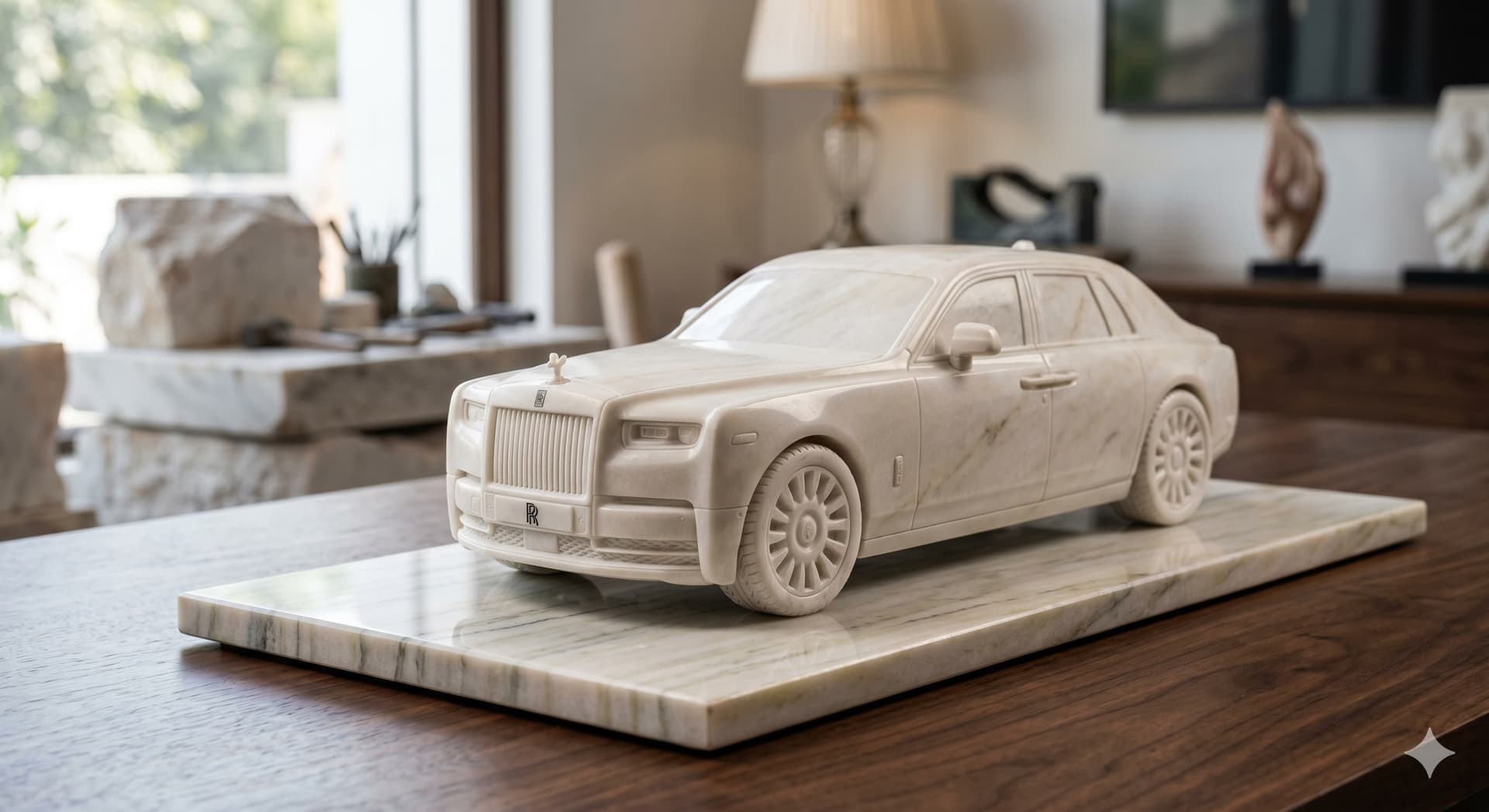
Abdul has been carving marble since he was eleven. His father carved before him. His grandfather before that. Three generations of hands shaped by the same stone, in the same town, working by the same methods — except that Abdul's grandfather carved for temples and his father carved for palaces, and Abdul carves for rooms across the Gulf that neither of them could have imagined.
We spent a day with him in Makrana, watching his hands.
The Town at Five in the Morning
Makrana wakes early. By five o'clock, the trucks are already moving on the roads around the quarry belt — long, flat-bed vehicles carrying blocks of stone out toward Jodhpur and Delhi, to the workshops, to the railways, to the shipping containers that will take Makrana marble to sites across Asia, the Middle East, and Europe.
The town's economy is stone. It has been for centuries. The quarries that supplied the Taj Mahal are still operating — some of the same pits, now cut deeper, producing the same calcite-pure white that Shah Jahan's architects specified in the seventeenth century. There are no other quarries anywhere in the world that produce stone with this specific combination of whiteness, hardness, and translucency.
Abdul's workshop is a short walk from the main quarry road. By the time we arrive at six, he is already working.
The Block
Everything begins with the block. Not every block of Makrana marble is suitable for figurative carving — the kind of three-dimensional sculptural work that Sang-e-Taj produces requires specific qualities. The grain must be consistent. There must be no veining, no colour variation, no micro-fractures that could propagate under the stress of detailed carving.
Abdul inspects every block before he agrees to work it. He runs his fingers along the surface, taps it with a small hammer and listens to the resonance. A block with hidden fractures sounds different. A block with inconsistent grain has subtle variations in colour that catch the light at the wrong angle.
"This one will carve cleanly," he says, using the kind of confident brevity that takes forty years to earn.
The Process
Makrana marble carving does not begin with machines. It begins with a paper template, traced onto the block with chalk. Then the rough shaping begins — removing large sections of stone with angle grinders and chisels to produce what carvers call the ghost: the approximate three-dimensional form of the finished piece, with all detail still buried inside the remaining marble.
This stage takes days, sometimes weeks, depending on the complexity of the design. An automotive form — the precise curves of a car body at scale — has compound curves that must be cut with extraordinary accuracy, because the marble has no tolerance for correction. Wood can be filled. Clay can be reworked. Marble can only be removed.
The intermediate stage involves hand chisels in a range of sizes: large ones for removing material, smaller ones for establishing planes, tiny ones — some no wider than a few millimetres — for detail work. The sound of a Makrana marble workshop is constant: a dry, percussive tapping, punctuated by the longer strokes of the angle grinder when a new section is being rough-cut.
The Detail
The surface detail is where the time goes. On a finished Sang-e-Taj piece, the surface texture communicates not just form but material knowledge — the suggestion of tension in a vehicle's bodywork, the play of light across the curve of a hull. This comes from abrasive finishing: a sequence of sandpaper grits, from coarse to ultra-fine, that gradually closes the crystal structure of the marble and produces the characteristic luminosity.
Makrana marble does something at this stage that no other stone does in quite the same way. As the surface closes, it begins to transmit light rather than simply reflecting it. The marble appears to glow from within — not because of any treatment applied to it, but because the calcite crystals themselves become semi-translucent when polished. The effect is why the Taj Mahal's interior appears lit even in the absence of direct sunlight.
Abdul holds a finished panel up to the window. The afternoon light falls through the stone. "This is the quality," he says. "Either the stone has it or it doesn't."
What Leaves the Atelier
By the time a piece is ready to leave Makrana, it has been through six to ten weeks of continuous work, depending on complexity. Abdul's hands carry the marks of the work: callused, precise, with a characteristic economy of movement that comes from knowing exactly how much force a chisel needs and never using more.
The finished piece is wrapped in cloth, then foam, then a custom crate built specifically for its dimensions. It travels from Rajasthan to the Gulf in conditions designed for objects of museum quality.
What arrives at a private residence or executive office in Dubai, Riyadh, or Doha is not decorative stonework. It is the product of three generations of inherited knowledge, a geological event 480 million years in the making, and six to ten weeks of hands that know this material better than anyone alive.
That is what you place in a room. That is what remains there.