There is one white marble on earth that has stood in the open for four hundred years without yellowing, cracking, or losing its luminosity. It is quarried from a single district in Rajasthan, India. It was chosen above all other stones to build the Taj Mahal. And it is the same stone, from the same quarries, worked by the same artisan families, that Sang-e-Taj uses today.
This is the complete guide to Makrana marble — also spelled Makhrana marble — covering its geological origin, historical use, unique properties, artisan tradition, and how to acquire a piece for your interior or collection. If you want to understand why this stone is different from everything else on the market, this is the place to start.
What Is Makrana Marble?
Makrana marble is a variety of metamorphic limestone — specifically calcitic marble — quarried exclusively in Makrana, a town in Nagaur district, Rajasthan, India. It is distinguished from all other white marbles by its molecular structure: an exceptionally dense interlocking of calcite crystals formed over approximately 500 million years of geological pressure.
The name 'Makrana' refers specifically to this geographic source. Marble from other Indian quarries, from Italy, from Greece, or from Turkey is not Makrana marble — even if it appears superficially similar. The geological conditions that produced Makrana's specific crystal structure exist nowhere else on earth. This is documented geology, not marketing language.
The alternate spelling — Makhrana marble — is equally correct and widely used, particularly across the Gulf region. Both spellings refer to the identical stone from the identical source. The variation reflects transliteration differences from Hindi and Rajasthani into English and Arabic.
Key Facts
- ◆Quarried exclusively in Makrana, Nagaur district, Rajasthan, India
- ◆Geological formation: approximately 500 million years
- ◆Primary composition: calcitic marble — high-purity calcium carbonate
- ◆Also correctly spelled: Makhrana marble
- ◆UNESCO World Heritage Site association: stone of the Taj Mahal
- ◆GI Tag (Geographical Indication): officially protected Indian product
The Geology — Why This Stone Is Structurally Unique
Marble is formed when limestone is subjected to extreme heat and pressure deep within the earth. Over millions of years, the calcium carbonate recrystallises into interlocking calcite crystals. The longer this process continues under the right conditions, the denser and more uniform the resulting crystal structure.
Makrana's marble formed over an exceptionally long geological period, producing a calcite crystal matrix of unusual density and uniformity. It is this molecular structure — not any additive, treatment, or processing — that gives the stone three properties no other white marble can match: resistance to yellowing, resistance to structural degradation, and a depth of luminosity that makes the surface appear to glow rather than simply reflect light.
Other white marbles — Carrara from Italy, Volakas from Greece, Statuario from Tuscany — are also calcitic marbles, but their crystal structures formed under different conditions over shorter timeframes. The result is visible: they all yellow with age. Makrana does not. The Taj Mahal, built in 1632 and exposed to monsoon rain, desert heat, and direct sun for nearly four centuries, remains the same white it was on the day of completion.
The Taj Mahal has been standing in the open for nearly 400 years. No laboratory test replicates this record. No other white marble has passed it.
The History — From Ancient Quarries to the Taj Mahal
Makrana marble has been quarried for at least 2,500 years. Ancient temples throughout Rajasthan were built with it. Mughal architects knew of it and specified it for major construction projects across northern India long before the Taj Mahal was conceived.
The stone's defining historical moment came in 1632, when Emperor Shah Jahan commissioned the Taj Mahal as a mausoleum for his wife Mumtaz Mahal. The project's chief architects, working from a brief that demanded absolute permanence and visual perfection, surveyed available stones across the known world. They chose Makrana white. No other stone was considered adequate.
The logistics were extraordinary. Over 20,000 craftsmen and 1,000 elephants were deployed to transport Makrana marble blocks from the Rajasthan quarries to Agra — a distance of approximately 200 kilometres across difficult terrain. Construction took 22 years, completing in 1653. The marble has not required structural replacement in the nearly four centuries since.
In 1983, UNESCO designated the Taj Mahal a World Heritage Site. The documentation formally records Makrana marble's geological uniqueness and its role in the monument's construction and preservation. When the Archaeological Survey of India undertook restoration work on the Taj Mahal in the 2000s, Makrana white was the only stone specified. No substitute was considered.
Key Facts
- ◆1632: Emperor Shah Jahan specifies Makrana marble for the Taj Mahal
- ◆1653: Taj Mahal completed after 22 years — marble structurally intact to this day
- ◆1983: UNESCO World Heritage designation formally records the stone's significance
- ◆2000s: Archaeological Survey of India specifies Makrana for all Taj Mahal restoration
- ◆Today: Same quarries, same artisan families, same geological seam — still active
The Four Properties That Set Makrana Apart
There are four properties that distinguish Makrana marble from all other white stones. Understanding them explains why the stone commands the premium it does — and why no substitute has ever been accepted for work where permanence is non-negotiable.
- ◆It does not yellow. Makrana's calcite purity is high enough that the oxidation process that yellows other white marbles does not occur at any meaningful rate. This is a geological property — it cannot be replicated by treating a lesser stone.
- ◆It has exceptional structural density. The interlocking crystal structure resists the micro-fracturing that causes other stones to degrade under thermal expansion, moisture, and physical stress.
- ◆It has distinctive luminosity. Makrana white transmits some light through its crystalline surface rather than simply reflecting it, producing a depth of appearance — a quiet radiance — that no opaque stone can match.
- ◆It is a single geographic source. There is no equivalent deposit anywhere else on earth. When the Makrana seam is exhausted, there will be no Makrana marble. This geological scarcity cannot be manufactured or replaced.
Makrana Marble vs Other White Stones
Buyers comparing Makrana to other premium white marbles ask the same questions. The comparisons are instructive.
- ◆Makrana vs Carrara: Carrara is grey-veined, softer, and yellows within decades of outdoor exposure. The architects of the Taj Mahal considered and rejected Italian stone in favour of Makrana.
- ◆Makrana vs Statuario: Statuario is a high-end Carrara variety with dramatic grey veining. Beautiful in contemporary interiors, but it yellows. Makrana is a consistent, pure white — no grey veining.
- ◆Makrana vs Italian marble broadly: No Italian marble has demonstrated the permanence of Makrana under outdoor conditions. The comparison is historical record, not opinion.
- ◆Makrana vs Chinese white marble: Softer, more porous, yellows quickly. Not a comparable material.
- ◆Makrana vs Thassos (Greece): The closest competitor in purity. Bright white and relatively stable, but lacks Makrana's specific luminosity and has no equivalent historical track record.
The Artisan Tradition
The quarries of Makrana have been worked by the same artisan families for generations. Their knowledge — of grain direction, cutting pressure, chisel angle, water cooling, polishing sequence — is not recorded in any manual. It exists entirely in the hands and is transmitted from father to son on the workshop floor.
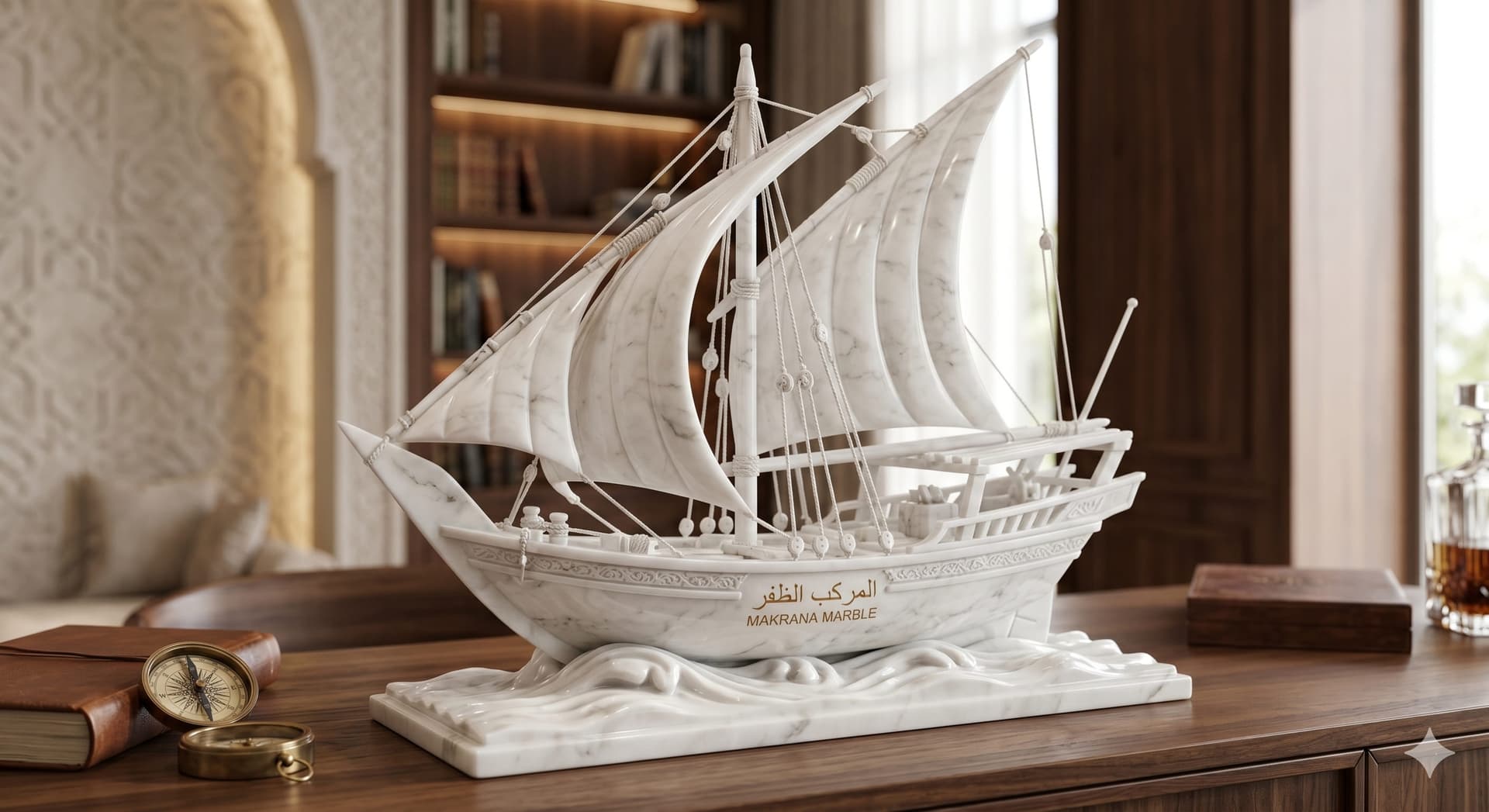
A significant Sang-e-Taj sculpture passes through the hands of three or four artisans. The rough carver establishes the primary form. The surface carver refines the geometry. The detail carver executes fine work — rigging lines on a dhow, body panels on an automobile, decorative elements on any bespoke form. The polisher brings the surface to its final condition. The lead artisan's name and generation are documented in the provenance certificate that accompanies every piece.
The Sang-e-Taj Collection
Sang-e-Taj produces two categories of Makrana marble showpiece: maritime sculptures and automotive sculptures. Both are permanent interior objects — designed to anchor a room and hold their position in it indefinitely.
The maritime collection takes the traditional Gulf dhow as its subject. The dhow is the defining vessel of Arabian Sea trade and Gulf identity. In Makrana marble, it becomes a statement about permanence — the sea, the culture, and the stone rendered in a form that will outlast any building it inhabits.
The automotive collection takes the luxury motor car as its subject. These are full sculptural interpretations of specific vehicles, executed in a material that will exist long after any production run has ended. The juxtaposition of the most perishable luxury object with the most permanent material is intentional.
The Geographical Indication — Official Protection
Makrana marble holds a Geographical Indication (GI) tag under Indian law — the same form of legal protection that covers Champagne, Darjeeling tea, and Parmigiano-Reggiano. Only marble quarried from the Makrana region of Rajasthan can legally be sold as 'Makrana marble' in India. The GI tag formalises what geology has always established: this stone comes from one place, and that place cannot be replicated.
How to Commission a Piece
Every Sang-e-Taj commission begins with a conversation. The brief can be specific — a particular vehicle, a vessel, an architectural form — or open: an object for a space of particular dimensions, a gift for a recipient of particular standing. Production timelines range from six weeks for standard pieces to sixteen weeks for complex or large-format commissions. Every piece is custom-crated and accompanied by its Certificate of Makrana Origin. Sang-e-Taj delivers to the UAE, Saudi Arabia, Qatar, Kuwait, Bahrain, Oman, and internationally.