The Craft
& Heritage
The stone beneath the Taj Mahal. The craftsmen who never left. The objects they make now.
500M+
Years of Geological Formation
400+
Years of Craft Heritage
1
Living Quarry Source on Earth
UNESCO
World Heritage Site Stone
“Makrana is not a type of marble. It is a place, a geology, and a four-hundred-year-old tradition of excellence that no other quarry on earth has ever matched.”
From the Taj to Your Interior
1632
Emperor Shah Jahan commissions the Taj Mahal. Architects specify Makrana white marble as the only stone equal to the structure's ambition. Quarrying begins in Rajasthan.
1648
The Taj Mahal is completed after 22 years. Over 20,000 craftsmen and 1,000 elephants transported Makrana marble across 200 kilometres from Rajasthan to Agra. Structurally and visually intact after four centuries — the only natural stone to survive this exposure without degradation.
1983
UNESCO designates the Taj Mahal a World Heritage Site. Makrana marble's geological uniqueness and its role in the monument are formally documented for perpetuity.
2000s
The Archaeological Survey of India specifies Makrana white marble for all restoration work on the Taj Mahal. No substitute stone is considered. The quarries remain the only authorised source.
Today
The same Makrana quarries. The same Rajasthani artisan families — now in their fourth and fifth generation. The same crystalline white marble, shaped into permanent interior objects for the finest spaces across the Gulf.
Makrana,
Rajasthan
Makrana is a small town in Nagaur district, Rajasthan. Beneath its surface lies one of the most remarkable geological formations on earth — a seam of calcitic marble so pure, so dense, and so resistant to time that it was chosen above all other stones for the most scrutinised construction project in history.
The marble's crystalline calcite structure forms at extreme pressure over geological time. It is this molecular density — not any treatment or additive — that gives Makrana white its luminosity, its resistance to yellowing, and its capacity to survive centuries of exposure without structural or visual degradation.
The quarries are still active. The same families still work them. The stone extracted today is geologically identical to the stone that built the Taj Mahal.
Why Makrana Has Never Been Replicated
Crystalline Calcite
Makrana marble's unique molecular structure — calcite crystals densely interlocked over 500 million years — prevents the yellowing that affects all other white marbles over time. It is a geological property, not a treatment.
Zero Synthetic Treatment
Unlike commercially processed marble, Makrana white is quarried and carved without synthetic additives, resins, or fillers. Its whiteness is geological in origin. It cannot be manufactured or imitated.
Single Geographic Source
Makrana marble exists only in one district of Rajasthan. The quarries are finite and irreplaceable. No other deposit anywhere on earth produces marble of equivalent purity, density, or optical quality.
Proven Over Centuries
Four centuries of outdoor exposure — monsoon rains, desert wind, thermal expansion, and direct sun — and the Taj Mahal's marble remains structurally and visually intact. No laboratory test replicates this record.
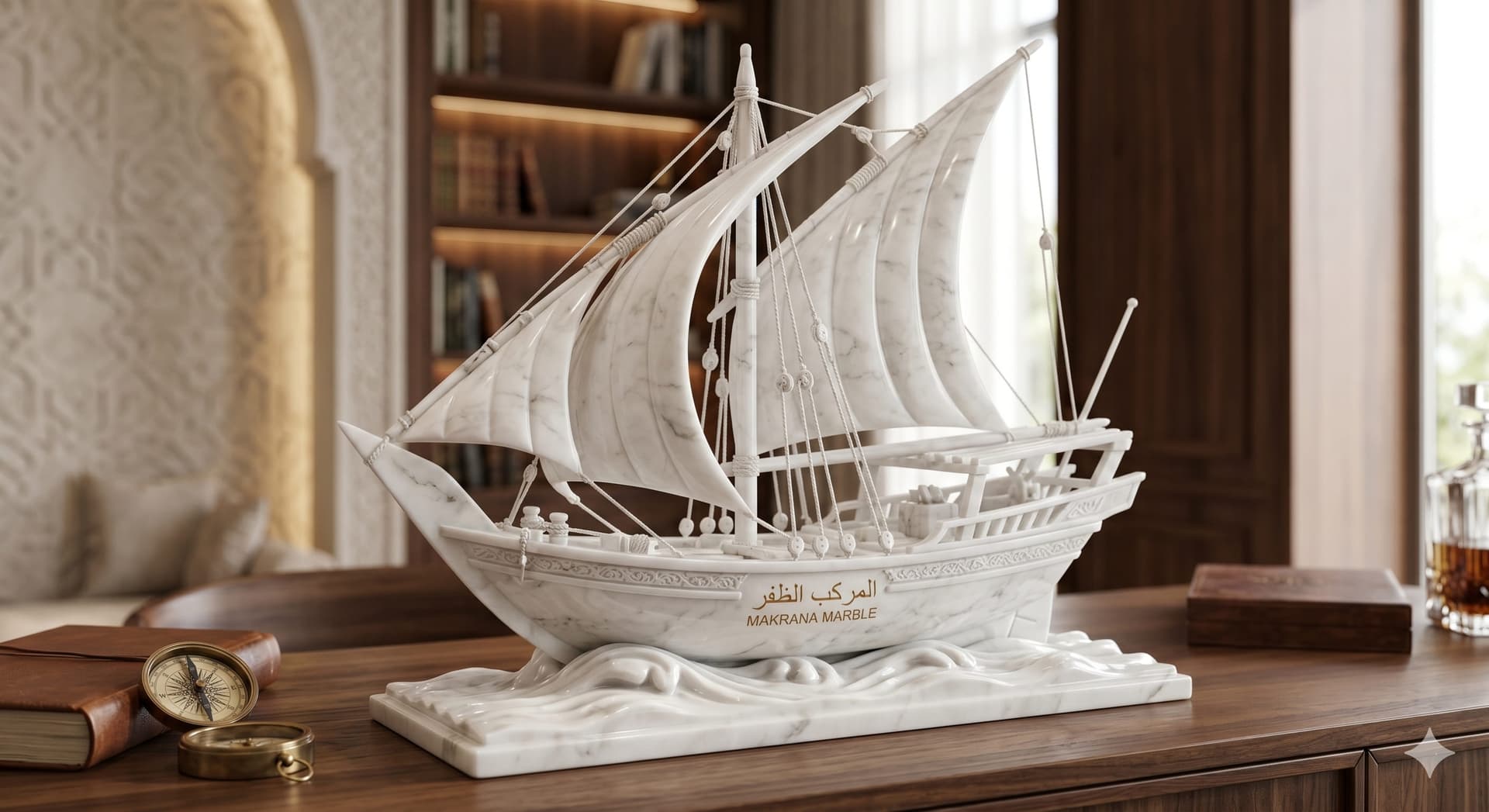
Sang-e-Zafar · Makrana White
Knowledge Passed by Hand
The artisan families of Makrana have been carving white marble for generations. Their knowledge — of grain direction, cutting pressure, chisel angle, water cooling, and surface polish — is not written in any manual. It lives entirely in the hands and passes from father to son on the workshop floor.
A single Sang-e-Taj sculpture may pass through the hands of three or four artisans, each responsible for a different stage: rough form, surface refinement, detail carving, and final polish. The lead artisan oversees and signs off on each stage.
Each Sang-e-Taj piece is assigned a named lead artisan. That artisan's name, generation, and work period are documented in the provenance certificate that accompanies every sculpture — a record that will outlast the building the piece stands in.
Every piece carries a name.
Each Sang-e-Taj sculpture is accompanied by a hand-signed Certificate of Makrana Origin documenting the lead artisan's name, generation, and work period. A record that will outlast the room the piece stands in.
The Same Stone.
Now in Your Interior.
Every object in the Sang-e-Taj collection carries this lineage — from the 500-million-year geology of the Makrana seam, through the Rajasthani craftsmen who have worked it for four centuries, to the room in which it will stand for the next four.
Explore the Collection