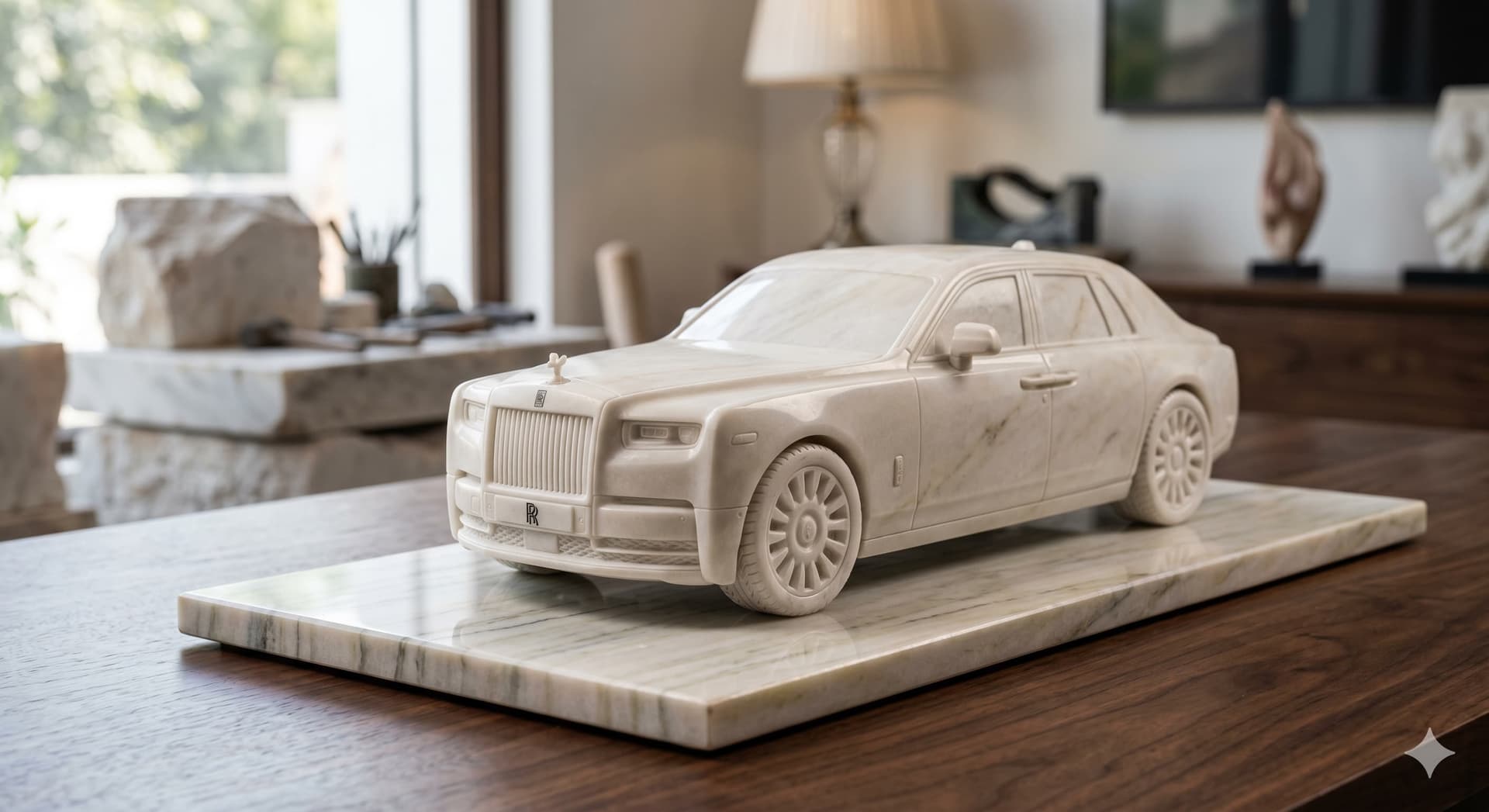
The reputation of Makrana marble has made it commercially attractive to misrepresent. White marbles from other Indian quarries, from Turkey, and from China are sometimes sold under the Makrana name — either in ignorance of the distinction or deliberately. Understanding how to identify genuine Makrana marble protects buyers from substitution and ensures the properties they are paying for actually exist in the stone they receive.
Visual Characteristics of Genuine Makrana
Genuine high-grade Makrana white marble is uniformly white with no grey, blue, or brown veining. It is not pure optical white — it has a warm, slightly ivory tone that becomes visible when placed next to stark white synthetic materials. In direct light, the surface shows a fine crystalline sparkle produced by its calcite structure; this is subtle, not glittery.
In diffused interior light, Makrana has a depth — a sense of internal luminosity — that distinguishes it from opaque stones. Hold it near a light source and observe whether the surface appears to have dimension or whether it is flat and reflective. Genuine Makrana appears to retain light rather than simply bounce it.
- ◆Colour: uniformly white with a faint warm undertone — not stark white, not grey
- ◆Veining: none in high-grade stone. Any significant grey veining indicates a different marble variety
- ◆Surface in light: fine crystalline sparkle, not glittery or metallic
- ◆Depth: visible luminosity in diffused light — the stone appears three-dimensional rather than flat
- ◆Grain: very fine and uniform. Coarse or irregular grain indicates a lower-grade or substitute stone
What Genuine Makrana Is Not
Any stone with pronounced grey veining is not Makrana — it is Carrara, Statuario, or another veined variety. Any stone with visible brown or rust-coloured mineral inclusions is not high-grade Makrana. Any stone that appears chalky rather than crystalline in direct light is not premium Makrana. Indian white marbles from Rajsamand, Kishangarh, or other Rajasthani quarries are not Makrana — they share a regional origin but a different geological seam.
Documentation to Request
A credible supplier of genuine Makrana marble should be able to provide documentation of the stone's geographic source. This may include quarry block records referencing Nagaur district, Rajasthan; a Geographical Indication (GI) tag certificate; or a detailed provenance document.
Sang-e-Taj provides a Certificate of Makrana Origin with every piece. This document records the stone source by quarry location within the Makrana region, the artisan responsible for the carving (including their generation and family lineage), and the commission period. It is a permanent record that travels with the piece and remains valid as long as the object exists.
The Simplest Test
The simplest practical test for Makrana marble is time. Genuine Makrana does not yellow. If a piece described as Makrana has yellowed — even slightly — it is not genuine high-grade Makrana. This test is of limited use when purchasing new stone, but it is conclusive for evaluating existing pieces.
For new purchases, the combination of correct visual characteristics, credible supplier documentation, and geographic provenance records is the most reliable verification available without laboratory analysis.