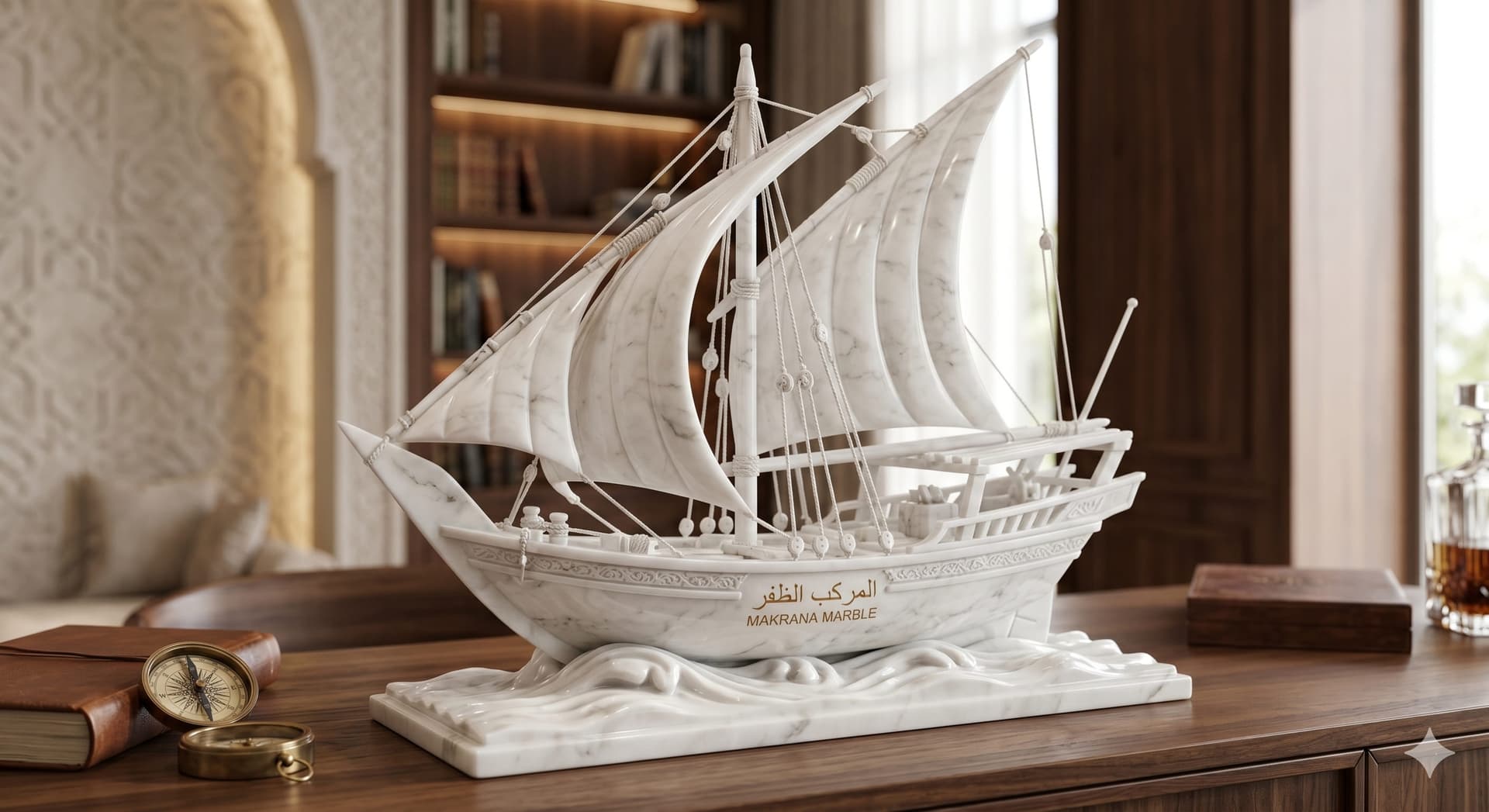
The dhow is not a boat. It is an argument — made in wood and sail — about who the Gulf is, where it came from, and what it built across six centuries of Indian Ocean trade. Before oil, before steel, before the skylines that now define Dubai and Doha and Riyadh, there was the dhow. And the families who sailed them.
What the Dhow Actually Was
The term dhow covers a family of vessels — the sambuk, the jalboot, the baggala, the boom — each with specific hull forms adapted to the trade routes they ran. What united them was the lateen rig: a triangular sail on a long yard, angled to catch the monsoon winds that made the Indian Ocean a highway rather than a barrier. These winds blew reliably — southwest in summer, northeast in winter — and the dhow was built around them.
For centuries, Gulf merchants ran routes from Basra to Zanzibar, from Muscat to Calicut, from Bahrain's pearl banks to the markets of Bombay. They traded dates and pearls outward, teak and spices inward. The dhow was the engine of this economy — which is to say, it was the engine of everything. The merchant families who owned fleets became the founding families of the Gulf's modern states. Their names are on the buildings now.
Before oil, before steel, before the skylines that now define Dubai and Doha, there was the dhow. And the families who sailed them.
Pearl Diving and the Weight of the Sea
The pearl diving season ran from May to September — four months of open water, with men diving to depths of thirty metres on a single breath, working from before sunrise to after sunset, filling mesh bags with oysters in the hope of finding what made the Gulf famous across the world. The nakhoda — the captain — commanded the vessel and the dive. His word was absolute. His relationship with his crew was one of the oldest forms of trust in the region.
The collapse of the natural pearl industry in the 1930s — when Japanese cultured pearls entered the market at a fraction of the price — was catastrophic for the Gulf economy. Entire communities were displaced overnight. But it was also the moment that made clear what the dhow and the sea had actually been building: not just wealth, but the habits of endurance, navigation, and trust that would define the Gulf's response to every subsequent challenge.
Why the Symbol Persists
Every Gulf state has the dhow on its currency, its institutions, its public art. The UAE's dirham carries it. Qatar's national museum is built around it. Abu Dhabi's Corniche is lined with them. This is not nostalgia. It is a specific and deliberate claim: that what the Gulf built before oil is as foundational as what came after.
In Gulf family culture, the dhow carries a more personal weight. For families whose grandfathers captained vessels or owned fleets, a dhow in the home is not decoration. It is a reference to lineage. It says: we were here before this was modern, and we built what you are standing in.
A dhow in the home is not decoration. It is a reference to lineage. It says: we were here before this was modern.
What It Means in Makrana Marble
When the dhow is carved from Makrana marble — the same stone that built the Taj Mahal, in a single unjointed block, with sails and rigging emerging from the same material as the hull — two things happen. The form is preserved with a permanence that no wooden model can claim. And the material adds its own layer of meaning: a stone from the Indian subcontinent, shaped by the same trade routes that the dhow once sailed.
The Indian Ocean connected the Gulf to India long before it connected either to the West. The dhow sailed those waters. The stone comes from that same geography. Placed in a majlis, a reception hall, or a private study, a Makrana marble dhow is not a replica of history. It is a continuation of it — in the most permanent material available to the craft.