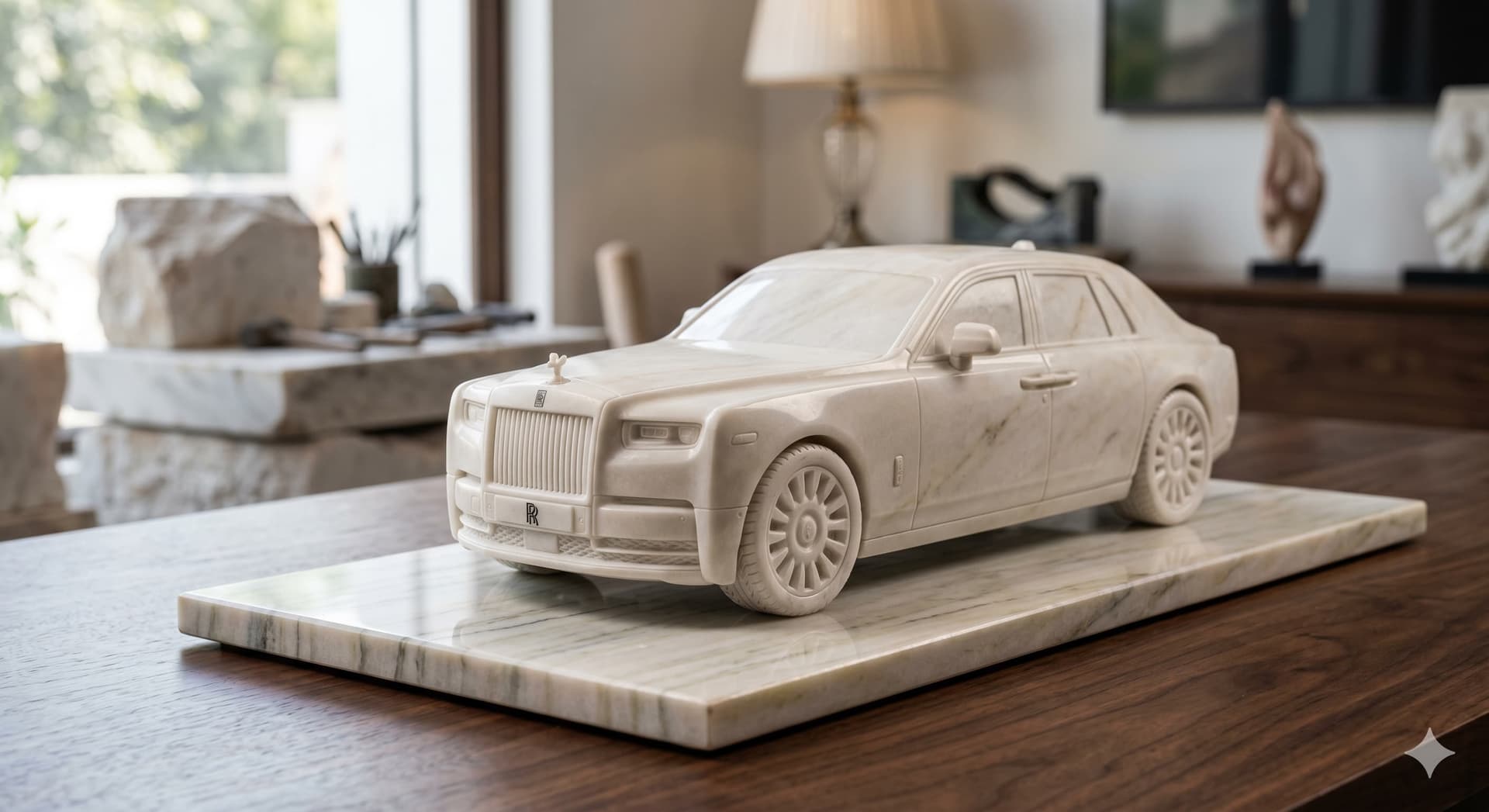
Most people who enquire about a commission have never done one before. They arrive with an image — a form they have seen somewhere, a space they are trying to complete, a gift they want to mean something — but no clarity on what comes next. The process, once explained, is straightforward. What makes it work is what you bring to the first message.
The First Message
The commission begins with a single enquiry. There is no form to fill, no catalogue to navigate. You describe what you are looking for — the subject, the setting, the occasion, the recipient — and the conversation starts from there. The more specific you can be at this stage, the more useful the first response. Three questions frame every commission: Where will the piece live? Who is it for? What should it say about them?
The space shapes everything. A piece destined for the centre of a majlis table behaves differently from one commissioned for an entrance foyer or a bedroom console. Dimensions, viewing angles, the quality of light at different hours — these are not aesthetic preferences. They are technical parameters that determine the form and scale of the work before a single line is drawn.
The Design Brief
Once the context is understood, a design brief is prepared. For automotive commissions — our signature category — this means working from reference imagery of the specific vehicle, agreeing on the exact stance and level of detail, and deciding which elements of the car's character the carving should emphasise. For maritime forms, heraldic subjects, or architectural ornament, the same principle applies: the brief fixes the creative scope so that no decision downstream is ambiguous.
The brief is not a constraint. It is the document that gives the artisan permission to begin — and the client confidence that what arrives will be what they imagined.
The Proof Piece
Before full production begins, a proof is made. For complex commissions this is a scaled reference carving — enough to establish the proportions, the depth of relief, and the finishing register before the final block of Makrana White is committed. The proof is submitted for approval. Changes at this stage are expected. Changes after this stage are expensive, which is why the proof exists.
Production in Makrana
The approved design travels to Makrana, where the stone comes from and where the work is done. Our principal artisan, Abdul, leads a family lineage that has worked Makrana marble for three generations. The craft knowledge in that lineage — the understanding of how this specific stone moves under a chisel, how it responds to different grades of abrasive, how the crystalline surface should catch light at the finished stage — is not transferable to another workshop in another city. It is why the work is done here and not elsewhere.
Production time for a standard commission is four to six weeks from brief approval. Complex or large-format pieces take longer. The timeline is given honestly at the start and updated throughout. No piece leaves the workshop before it meets the quality standard agreed in the brief.
Packaging, Delivery, and the Certificate of Origin
Finished pieces are packed in custom timber crates with foam-lined internal supports shaped to the specific form. Each commission is accompanied by a certificate of origin confirming the stone source, the artisan, the quarry region, and the date of completion. This document is part of the piece. It is what makes the object traceable, and what distinguishes a commission from a purchase.
The reason to understand this process before you begin is simple: the commissions that produce the best outcomes are the ones where the client arrives knowing what they want to say. The process does not generate ideas — it executes them with precision. The more clearly you can describe your intention at the start, the closer the finished piece will be to the object you imagined. That clarity is worth more than any other factor in the making.